Can You Store a Jet Ski On A Moving Boat?

Store Jet Ski On Boat

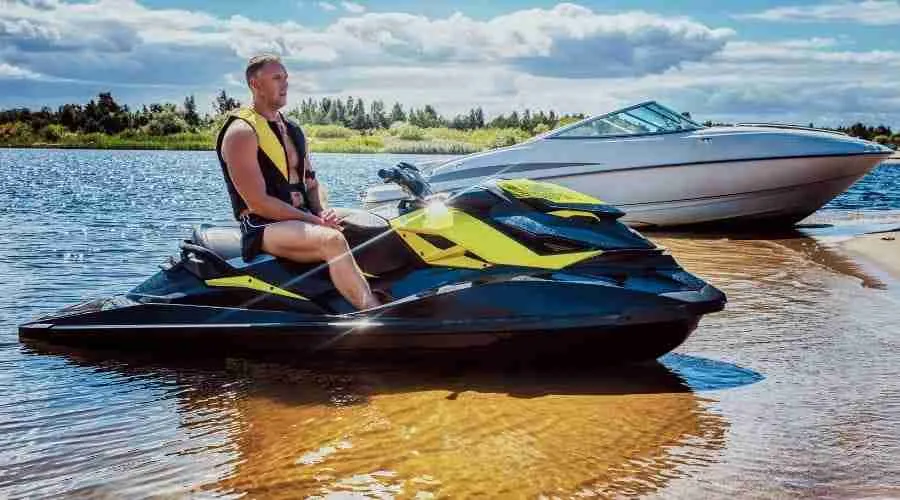
Have you ever wondered if you can store a full size sit down jet ski on a boat? Well, there are some things to really consider here.

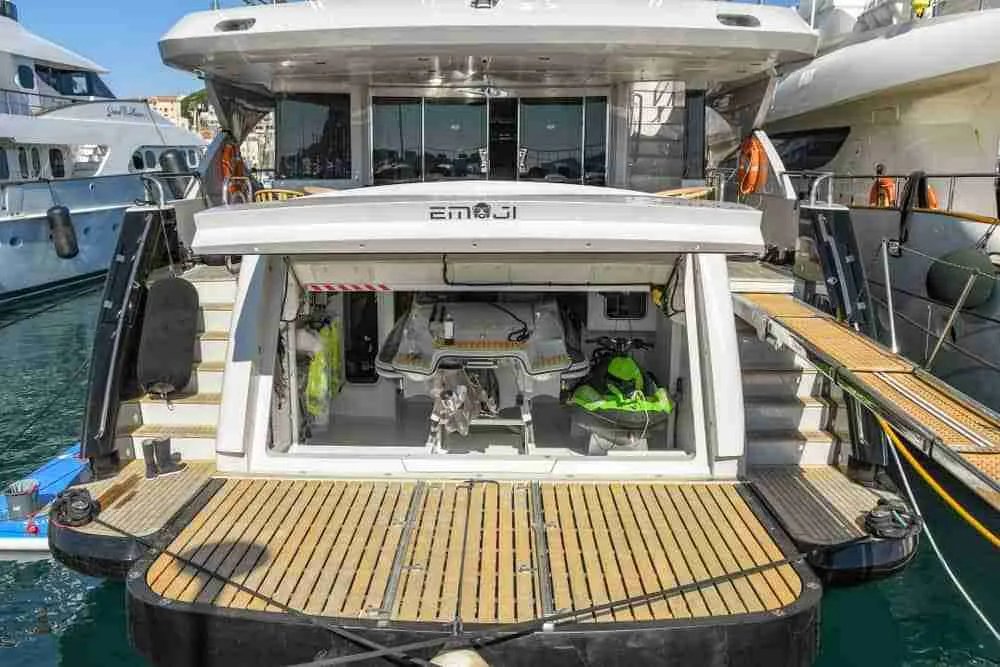
Generally speaking, you can store a jet ski on a boat which is at least 40 feet long and has a davit to haul up the jet ski, or a rear tender garage for storage. However, the additional weight at the rear of the boat will impact the performance of the mother vessel, so I recommend storing recreational jet skis on boats which are 60′ feet or longer.

Some superyachts have extensive garages that can store multiple jet skis, but for the typical owner, this is well beyond their means. Often the boat isn’t designed for an additional 800-pounds at the rear.

In this guide, I’ll be talking about some of the real challenges and nuances that come with jet ski storage on boats.

Bringing Jet Skis On Boats

It’s not so clear-cut as to whether you’re able to bring a jet ski with you on the boat. A fishing vessel, for example, probably won’t have the storage space anywhere for a PWC despite having a davit (a crane used for lifting things out of the water) on board.

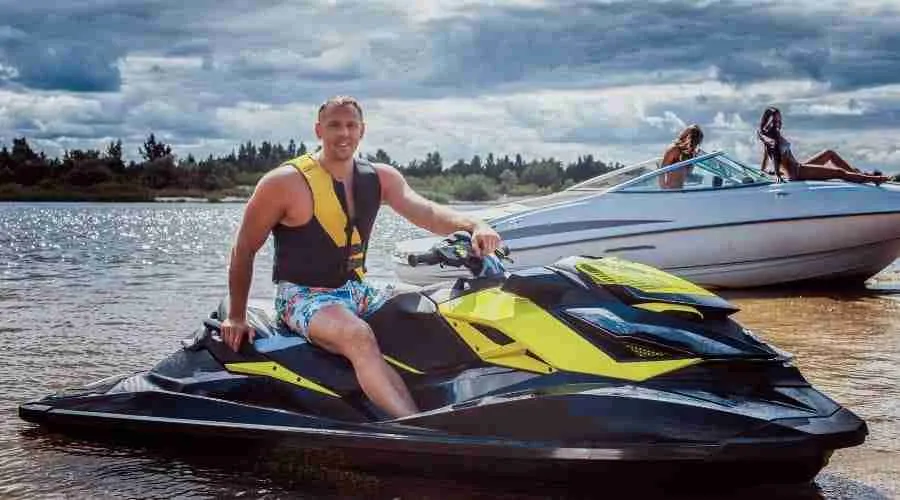
However, there are certain cruisers designed for bringing additional toys out there on the waterways. They’ll either have additional rear deck storage or a tender garage which can fit a full-sized jet ski. However, the tender will need to be stored elsewhere or towed behind the cruiser while underway.

This is prefered than towing the jet ski itself. Given the tender is often much lighter, and indeed much less expensive too, it’s just better all-round. You’ll get better mileage and higher cruising knots than if you were towing the ski.

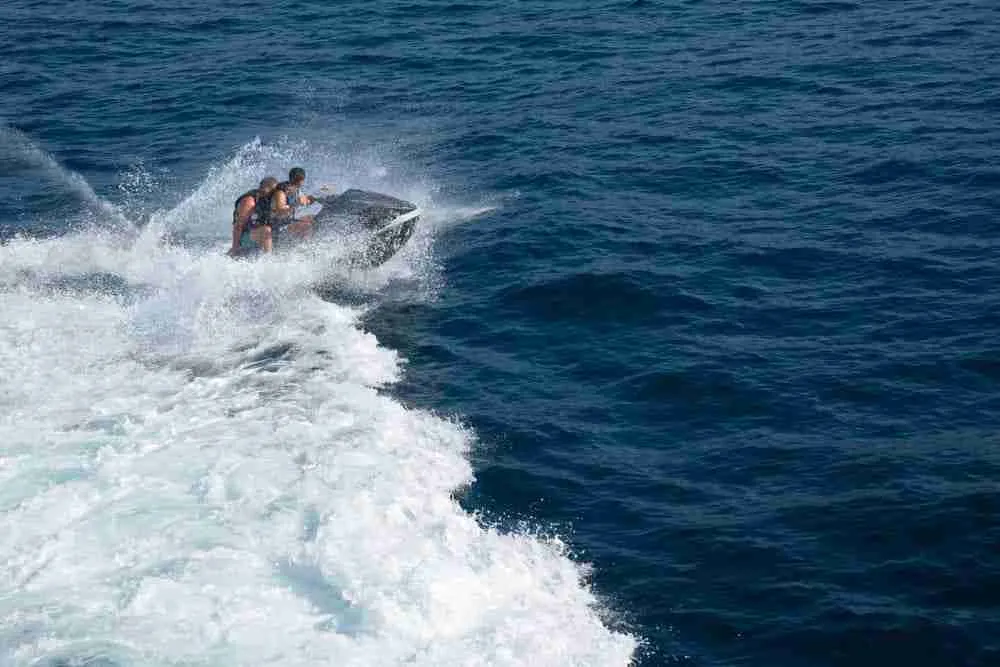
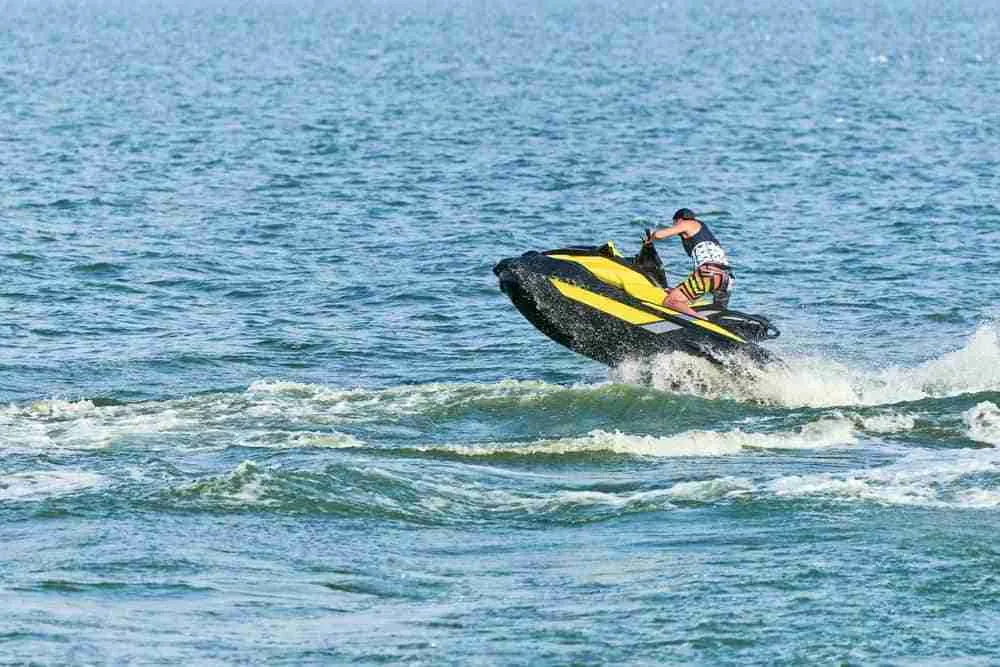
What some people do – especially in calmer areas like the Florida Keys or Queensland coastlines, is actually have a member of their travel party ride the jet ski. This is a lot of fun and you can use the main cruiser vessel to create a wave bow which is a lot of fun for jet ski jumping!

Things To Consider

Before you think about getting out there and buying a jet ski to take along with your crusing adventures, there are some things to remember.

  1. Do you need to really bring a jet ski? Some places aren’t so desirable to ride in.
  2. What will you store your jet ski on? Well, I’ve actually written a guide about jet ski stands which is helpful. You’ll need to make one of these custom for your boat.
  3. Can you hire one when you get there instead? The best jet ski riding areas actually have places where you can hire one, however admittedly, these are underpowered and designed for beginner riders.
  4. The additional weight impacts your boat’s performance. Chances are that you’ll add in 300kg/1,000lbs extra (likely more) of weight that your boat will have to handle. This changes the way in which it planes across the water and your gas consumption will climb. It’s best to count this weight as an additional 4 passengers as a safety precaution.
  5. You’ll need to store additional gas. While your boat may run on diesel, jet skis run on ordinary gas/petrol so you’ll need some gas cans to bring for riding in more remote locations.
  6. You may not be able to bring a tender. If your jet ski is taking up additional space on the boat, then you may not have space for a tender. This makes it tough when you’re doing island hopping as your entire travel party will have to go 1 or 2 at a time.
  7. You might have to install a davit. Any good marine davit is going to cost a few thousand dollars and does need strong mounting points plus electrical wiring, while taking up additional room on the deck of your boat. This wouldn’t really apply if you have a rear tender garage with winch.

Another thing to consider is that if you do cross countries, then you’ll need to ensure the jet ski is registered and that you have a licence. It will need to go through the same formalities as your main vessel and tender.

In Summary

Bringing a jet ski along for your next multi-day adventure out there on your boat is a great idea. However, it does bring with it some additional headaches.

I’d recommend that you actually bring the jet ski seperately when you’re transitioning between islands or anchorages. This means that someone has all the fun of riding and without the stress of trying to store the ski somewhere on the boat.

Above all else – have some fun out there!
Premium PWC Gas vs Normal Gas: Which one to refuel with?

Jet Ski Premium Gas

Have you ever wondered if you should be refuelling with premium fuel or just normal fuel? Well, after spending several hours through looking the responses inside a large jet ski riding community, I was able to draw some findings which didn’t surprise me that much.

It’s best for the longevity and performance of a jet ski engine to be running on premium fuels such as 95 and 98 octanes. Yamaha, SeaDoo and Kawasaki have all designed their jet skis as performance-orientated machines. Further still, their user manuals often clearly state the requirements for premium fuels to keep their warranty valid.

Jet Ski Fuel
Premium pwc gas vs normal gas: which one to refuel with? 5

As I recently found out, the overwhelming majority of jet ski owners do stay away from 91 octane and below.

Choosing The Right Fuel for the Tank

Certainly, the first time you go to fuel up your jet ski at the gas station, you’ll be wondering what you should do. You might be sold on the idea of premium fuel, but unsure if you should choose 95 of 98.

Truth be told that both are excellent, but 98 is certainly a better choice. Yes, your jet ski doesn’t NEED it but it will run cleaner with it with a potential increase on performance in both acceleration and top speed, though such improvements will be barely noticeable.

Not only is choosing to go with premium fuel options important for cleaner burning and performance, but it can stop your jet ski from premature engine failure. The lifecycle of PWCs is sadly quite short (100 hours is considered ‘rich’) and this is due to the constant aggressiveness of the engine.

It’s not just the main fuel tank but any auxiliary fuel you’re carrying too that should be premium.

Is The Gas Station Brand Important?

Well, that depends on how much you value your jet ski. I generally stay away from the no-name gas stations around me as I’ll never be too sure where they get their petrol from.

In other words, I don’t go for the cheapest price in town. As it costs a lot of money to buy a jet ski outright, it can also cost a lot to repair or replaced a seized engine.

This is why I’ll go with trusted brands like BP, Shell and Mobil as it’s unlikely that I’ll get a bad batch of gas in my tank. That said – I know of some people that this *has* happened to recently which was worrying when you’re 5 nautical miles offshore.

What Happens If I Run 91 Octane?

To be honest, I’m not sure as I’m not excited enough to try this out. 91 Octane might be alright for the rental businesses as their riders generally aren’t hitting the redline, but not ideal for jet ski owners.

I imagine the engine would have a slightly harder time getting up to speed and would somewhat run a little weird. You might even hear this when you’re idling at the dock or boat ramp.

While your jet ski won’t blow up in the first hour of running 91 octane, prolonged use could cause a premature retirement for your machine. I’d take it if that’s all which is available, but remember that you could be voiding your warranty by using lower grade fuels.

In Summary

For the few extra cents that it costs, you get the peace of mind that you’re looking after your engine. The last thing you want is your engine to be running strangely as it’s a sure-fire way to spoil your day out there on the water!

Just about everyone runs premium.

Riding PWCs in the Ocean Riding vs Rivers: Which is best?

Jet Ski Riding In Freshwater

Have you ever wondered whether it’s best for you to ride your jet ski in the saltwater, or retreat to staying in lakes and rivers?

Well, there are numerous factors that come into play here.

In most cases, jet skis are best ridden in freshwater environments for beginners and those without the physical ability to handle small waves and swell. Riding a jet ski in the open ocean is best tackled by more experienced riders with larger, performance-orientated watercraft.

Jet Ski Ocean Vs River
Riding pwcs in the ocean riding vs rivers: which is best? 9

In this guide, I’ll go a little deeper on this topic to help you get the most of where you are today in this journey of PWC ownership.

Let’s begin.

Jet Skis: Freshwater vs Saltwater

One of the key reasons why I often recommend freshwater riding over salt water riding isn’t just the fact that the surface is significantly flatter, and you’re less likely to get stranded, it’s actually for longevity. Salt water is quite corrosive even to modern-day jet skis. This is why their engine hours are quite short (100 to 200 hours) because that salt really finds its way into your engine bay.

So if you’re new to jet ski riding and you have a limited budget, then I’d try to stick to freshwater environments as much as possible. Sure – you’ll still have to wash out your engine but it’ll be a brief wash without the need for products such as Saltaway.

Now, let’s look into other reasons why you’d want to avoid the ocean on your PWC, at least for now.

Easier to Get Help

When you’re starting out as a beginner with a jet ski, there is a sense of nervousness towards the day ahead. You’ll check that drain plug 3 times and hope that no one’s paying attention to you as you unload at the boat ramp.

If you do get stuck out there in the waterways, then it’s far easier to get some assistance in freshwater environments than salt water. You won’t have tide or current, though in a river system you may drift slowly downstream but it’s nothing like the open ocean.

Waterside Camping

One of the most wonderful things about jet ski ownership is the camping ability. You can pull up at one of the hundreds of river-side camping areas around the country and stay for a few nights and really enjoy some time away.

It’s hard to beach a jet ski in saltwater and leave it parked up overnight securely. It’s not just theft that you have to worry about either, since the tidal movements could see your jet ski beached or in deep water and dragging anchor. This also brings us to the next point…

Towing Tubes and Skiers

I’d always get a fear of towing tubes in saltwater and my passengers being attacked by a shark or crocodile if they fall off while the jet ski circles around. This is a key reason why freshwater is so much better. It’s not just this as well, since the swell/chop is much less meaning they’re less likely to fall off.

You’ll also find that freshwater is slightly less corrosive to metals and plastics. If you’re seeking to get more than one season from your gear, then aim for the nearby lake or river.

Less Weather Influence

As I partially just mentioned, you won’t be so impacted by the swell and small waves in freshwater environments. Even if you get a thunderstorm rolling through, you’ll be able to get some shelter pretty easily. Let’s not forget sun protection! When you’re out there in the middle of the day, having a break under a shady tree is the perfect escape.

In Summary

Yeah…I’m biased but I also like to enjoy my days out there on the waterways and not have salt water coming out of my nostrils that evening. Plus I want my PWC to retain its value and really be able to get the most hours out of my investment.

So it’s freshwater for me (most of the time…).

Stay safe and I’ll catch you out there!

12 Reasons Why Your Jet Ski Won’t Start (2022)

Untitled Design5

It’s a scary thought when your jet ski won’t start and you’re worried about the expensive repair bill at the dealership, or the thought of being stranded.

Through this guide, I’ll be helping you diagnose the core problems with jet skis that don’t turn on when you hit the start button. Essentially, most of the problems you’ll encounter are actually quick fixes.

Editor’s Note: Avoid messing around with your starting system and battery unit unless you have electrical knowledge. These carry high volts and may cause injury or death for the individual who lacks knowledge and expertise. If in doubt, always use a licence personal watercraft dealership for repairs, servicing and diagnostics.

Reasons Why Jet Ski Won’t Start

In most instances, it’s the battery that is causing the problems with your jet ski not starting up.

Pwc Diagnostics: Reasons Why Your Jet Ski Won'T Start
Go through this diagnostic list to see the common reasons why your jet ski won’t start.

Let’s unpack all the common faults for Yamaha, Sea-Doo and Kawasaki here:

1. Weak or Bad Battery

Batteries on jet skis are designed to last 2 to 3 years in normal conditions. If you use your jet ski more frequently (say every weekend) then their lifecycle reduces especially as they have mild exposure to salt water despite being tucked away in the engine bay.

You can now buy batteries online and they ship really fast. Check out these batteries for instance. I actually recommend ordering one as a spare so you can quickly change it out even if your current battery is good.

2. Jet Ski Has Sucked Up Something

Check the rear end of your jet ski to see if it has sucked up something like a rope, stick, rocks, plastic bags or even a sea creature. True! I’ve found several jet skiers who have sucked up little fish into their intakes.

To prevent your jet ski from sucking up debris, don’t run it so close to shore. Essentially you’ll want momentum and turn off the engine when you’re in less than 1 meter of water before reaching the sand.

3. Bad Starter Relay

Your starter relay could be shot through. Unfortunately, the easiest way to handle this is to take it into the dealership. If you’re under warranty, then your warranty could be voided if you choose to take on the work yourself even if it’s a quick part replacement.

4. Broken Button

The button used to start your jet ski could actually be faulty. This isn’t common but I’ve seen it before. If you’ve got a new battery installed and the relay looks fine, then the culprit could be the $3 button that the manufacturer installs in the factory which isn’t engaging.

5. Bad Alternator

Your alternator may not be charging the battery when you’re riding. It’s a total disaster when you reach a beach and go for a ride, only to try and start up later and there’s no life left. That’s going to be an embarrassing call to the coast guard and my recommendation is to pack a spare solar battery charger just in case. These are very affordable and pack easily into the front storage locker.

6. Blown Fuses

Have you checked your fuses? This often can be a fault of multiple other issues too. One quick check of that fuse panel and you may find other issues. Also, check the starter motor solenoid.

In some models, there is more than one fuse box so don’t assume you’re seeing every single fuse there. Consult your owners manual for the full low-down and you can find these online.

7. You Copied The Key

When getting a new set of jet ski keys, you actually can’t have the key copied by a locksmith. It has to be done by an authorised dealership and many beginners make this mistake.

Go and get your original key and throw the ‘copy key’ in the trash as it’s useless. Modern-day jet ski keys have special codes designed to prevent theft which is matched up to the jet ski and only dealerships can assign new ones.

8. Faulty Fuel Injectors

Another less obvious problem is the fuel injectors. If your jet ski has sat idle for years then this is a common issue. It’s not that expensive actually to replace the fuel injectors.

If you’re using an older jet ski which hasn’t been started for several years, then consider some fuel treatment concentrate. This can cure ethanol problems within the engine bay.

9. Fuel Pump Issues

How old is the fuel you’re running? Is the fuel pump in good working order? You can’t start a jet ski without a solid fuel pump as well as hoses which are primed properly.

With this you’ll want to check the pump, its hoses and the fuse. And…I’m sorry to mention this one…but is there fuel in the tank? Have you physically looked inside the fuel tank?

10. Bad Spark Plugs

Bad spark plugs are common in cars just as they are in jet skis. These are super cheap to replace and you can find brand new spark plugs available right on Amazon. These take a few days to ship so I recommend dropping into your local automotive store who typically has spark plugs capable for jet skis.

11. The Jet Ski is Hydrolocked

Have you already tried flushing out your jet ski the wrong way? This is a common mistake. I’ve written a guide here on how to properly flush it out. A hydro-lock in a jet ski means that water can’t escape internally and you’re stuck (as is the engine) and you really need a dealership to rectify this. This applies to Sea-Doo, Yamaha and Kawasaki.

12. Technical PWC Faults

Jet skis today have multiple computer systems on board. As a result, there are technical issues that are beyond the scope of the average rider to be diagnosed. Again – another reason why the dealership is the best idea as they have the experience and the systems to hook it up and check out your jet ski error codes.

More Assistance

If you need more assistance, you can leave your question below and I’ll do my best to help you out. Firstly, however, use this list and tick off each one as you go.

If you call the dealership, then their #1 advice will be to bring it in for diagnostics. How much will this cost? Anywhere from $150 to $700+.

For that reason, see how you go tinkering along yourself but remember the risks associated with batteries. Leave that for the experts!

Lost Jet Ski Key: Where Do I Get A New One?

Lost Jet Ski Keys

The moment when you’ve lost your jet ski key can really spoil the rest of your day. Who has the key? Are they going to steal your jet ski?

It’s actually quite common for people to lose the keys to their jet ski, whether that’s a Yamaha, Sea-Doo or Kawasaki. So they – how do you get a new key?

How To Get a New Jet Ski Key

It really depends on the make of your jet ski and its age as to how easily you’ll get a new key. In the following table, we’re showing you the keys, the level of difficulty and the price you can expect for a key replacement.

These are how much new jet ski keys cost:

MakeDifficultyNew key cost
Sea-Doo Pre-2015Medium$100 to $200
Sea-Doo Post-2015Easy$70 to $150
YamahaEasy$70 to $150
KawasakiMedium$85 to $170
Tiger SharkHard$150+
PolarisHard$150+

Note: The Tiger Shark and Polaris jet ski keys are hard to get the manufacturer keys duplicated, but you can actually use a locksmith and in most cases, you’ll get an identical key. As these are older models, they don’t have the tech the newer jet ski manufacturers have to prevent theft.

Lost Jet Ski Keys While At The Beach
I have lost jet ski keys before while at anchor. It was quite distressing!

The easiest way to get a new jet ski key is to take your jet ski into a dealership. You CANNOT simply bring them the spare key and ask them to duplicate it. They will need your actual jet ski in the workshop so they can assess your particular model. It’s also best to call the dealer for an appointment before you take your jet ski in.

To stop this from happening next time, check out these products:

These floats are super handy as they will prevent your jet ski key from sinking to the bottom of the ocean.

The Technology of Jet Ski Keys

Unlike a car, jet ski keys are actually programmed differently. This is because there is a, comparatively speaking, a high theft rate of jet skis. Thieves often consider them to be a hot item that can be resold quickly.

Imagine your jet ski being stolen and while you have the keys, someone else is already riding it out there tomorrow with new plates!

Lost Jet Ski Key
It’s often a case of losing your jet ski keys for a moment or temporarily.

Personal watercraft keys have these two components:

  1. The magnet. This allows the jet ski to be turned out as it recognizes its presence.
  2. The ROM Chip. This is the tech which has a combination of digits embedded and it’s the reason why you simply can’t take in your spare key. Each key simply has a different string of numbers embedded or hard-coded into each key hence why duplication is essentially impossible.

Older jet ski models don’t have this technology such as the Tiger Shark and Polaris, as they ceased production years ago.

Bypassing a Sea-Doo DESS Key

It’s almost impossible to by-pass a Sea-Doo DESS Key. We say almost impossible as there are documented cases of people being successful doing this, but these are rare and often does more harm than good for the industry.

The key data is what will catch people out who try to bypass this technology. Sea-Doo in particular have done this as they want to protect their loyal and honest customers.

Two Jet Skis With The Same Keys

You can have two jet skis and have the same key able to start both. How? Ask your dealer provided they are the same manufacturer. They can program the key before pick-up.

The real advantage here is that if you lose one of your keys, you still have the other available at home. Even if it’s just a starter key, it’s enough to get you going.

Are You Losing Keys?

If you’re losing keys or are fearful of losing keys, then I recommend that you have a jet ski lanyard that is fluorescent and floats. Personally, mine is huge so I can’t miss it and it’s on my checklist of things to take with me to the boat ramp, including the plug and extra fuel cans.